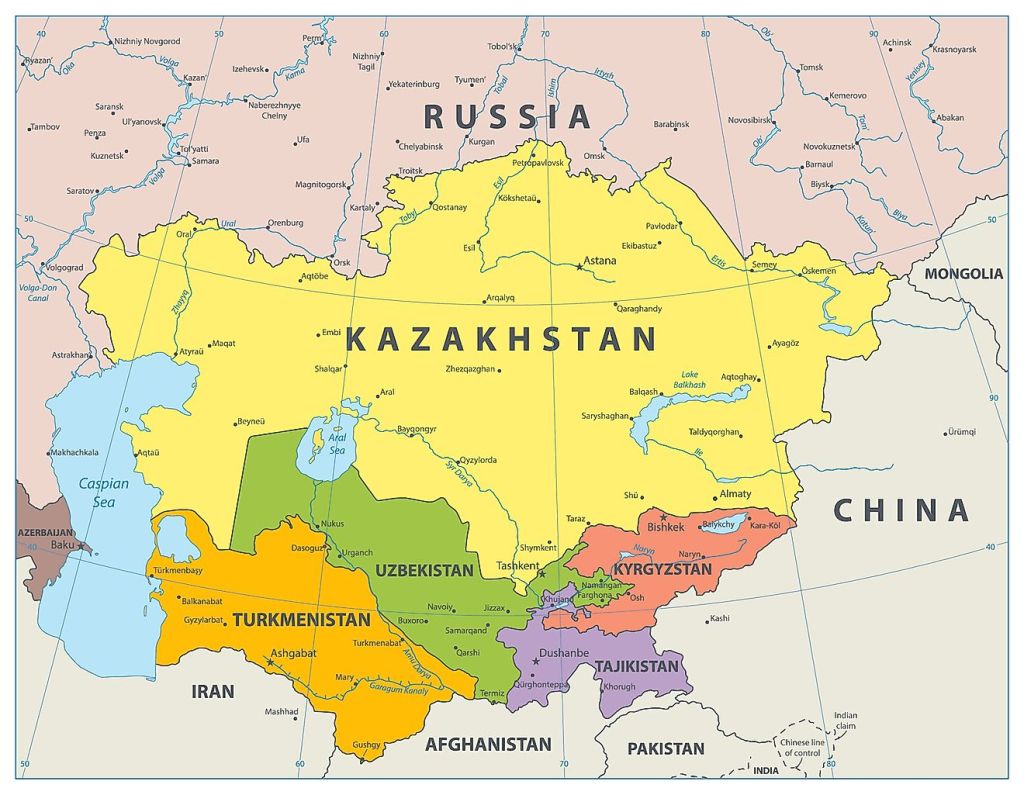
Central Asia: Balancing Great Power Rivalries, Regional Security, and Economic Potential
Introduction
Central Asia, bordered by major powers like Russia, China, and Iran, is a region rich in natural resources, cultural diversity, and strategic importance. The five former Soviet republics—Kazakhstan, Uzbekistan, Turkmenistan, Kyrgyzstan, and Tajikistan—have pursued varying paths since the dissolution of the USSR in 1991, navigating complex relationships with neighboring powers while working to assert their sovereignty and regional cooperation. Despite Central Asia’s potential as a major trade and energy hub, it faces significant challenges, including internal political tensions, economic dependency, environmental concerns, and security threats. This analysis examines the region’s key dynamics, ongoing conflicts, and the influence of external actors that continue to shape Central Asia’s future.
Kazakhstan: Economic Growth and the Challenge of Political Reform
Conflict Overview:
Kazakhstan, the largest and wealthiest Central Asian state, has leveraged its vast natural resources—oil, gas, and minerals—to foster economic growth. However, this wealth has not translated into broad-based prosperity, with economic inequality sparking protests. The January 2022 unrest, which began over rising fuel prices, quickly escalated into the country’s largest anti-government protests since independence, revealing deep-rooted frustrations with corruption and limited political freedoms.
Current Dynamics:
In response to the 2022 protests, President Kassym-Jomart Tokayev has pledged reforms, including measures to decentralize power and reduce the influence of Kazakhstan’s oligarchic elite. Kazakhstan’s economic growth remains dependent on oil exports, making diversification essential for long-term stability. Kazakhstan also finds itself balancing relations with Russia—its former Soviet ruler and a key ally—and China, which has invested heavily in Kazakh infrastructure as part of the Belt and Road Initiative (BRI).
Key Actors:
- Kazakh government, led by President Kassym-Jomart Tokayev
- Russian government, maintaining close military and economic ties with Kazakhstan
- Chinese investors, focused on infrastructure and energy projects
Implications:
Kazakhstan’s political stability is crucial for Central Asia. Any significant unrest or shift in alignment could impact regional security, as Kazakhstan’s geographic size and resource wealth make it a cornerstone of Central Asian geopolitics. Additionally, how Kazakhstan manages its relationship with Russia and China will influence the region’s balance of power.
Uzbekistan: Economic Reforms and Regional Leadership Aspirations
Conflict Overview:
Since the death of long-time leader Islam Karimov in 2016, Uzbekistan has embarked on a series of economic and political reforms under President Shavkat Mirziyoyev. While these reforms have opened up the economy, attracted foreign investment, and improved regional relations, challenges remain, including corruption, human rights concerns, and limited political freedoms.
Current Dynamics:
Mirziyoyev has focused on modernizing the economy, reducing dependence on agriculture, and promoting industrial and technological sectors. He has also sought to transform Uzbekistan into a regional leader by mediating regional disputes, particularly over water resources, and fostering trade links. However, democratic reforms have been limited, and criticism of the government is still tightly controlled.
Key Actors:
- Uzbek government, led by President Shavkat Mirziyoyev
- Foreign investors, particularly from Russia, China, and Europe
- Neighboring countries, with which Uzbekistan seeks closer economic ties
Implications:
Uzbekistan’s reform trajectory could serve as a model for other Central Asian states, though maintaining momentum will be essential. As Uzbekistan strengthens its regional leadership role, particularly in resolving water disputes, it could foster greater cooperation across Central Asia. Its relationship with China, and to a lesser extent with Russia, will remain pivotal as it seeks to balance foreign influence with national interests.
Kyrgyzstan and Tajikistan: Border Disputes and Socioeconomic Challenges
Conflict Overview:
Kyrgyzstan and Tajikistan, two of Central Asia’s most impoverished countries, struggle with internal instability, weak economies, and recurring border disputes. The most recent clashes in 2022 over disputed sections of the border led to significant casualties and displacement, with both countries accusing each other of aggression.
Current Dynamics:
Border tensions are fueled by competition over water and land resources in the densely populated Fergana Valley, where borders are complex and poorly demarcated. In both countries, high unemployment and poverty drive labor migration, with many citizens working in Russia and sending remittances home. Political instability is also a factor, especially in Kyrgyzstan, which has experienced multiple revolutions and government turnovers in recent years.
Key Actors:
- Kyrgyz and Tajik governments, each asserting territorial claims
- Local communities in disputed border areas, often caught in the conflict
- Russian government, maintaining influence as a mediator and economic partner
Implications:
The Kyrgyzstan-Tajikistan border conflict risks destabilizing the region, particularly if violence escalates. Increased cooperation on resource sharing and demarcation could help ease tensions, though both governments face internal pressures that complicate diplomacy. These tensions also underscore the need for regional frameworks to manage water and land disputes, which will become increasingly important as climate change affects water availability.
Turkmenistan: Isolation and Economic Dependency on Energy Exports
Conflict Overview:
Turkmenistan is one of the world’s most isolated countries, with a tightly controlled government and limited civil liberties. Its economy is heavily reliant on natural gas exports, primarily to China, making it vulnerable to fluctuations in energy demand and prices.
Current Dynamics:
Under President Serdar Berdimuhamedow, who succeeded his father in 2022, Turkmenistan maintains its policy of neutrality, avoiding regional entanglements and keeping foreign influence at bay. However, economic difficulties have worsened due to limited diversification and a dependence on energy exports. While Turkmenistan has been largely absent from regional diplomacy, it participates selectively in initiatives related to energy infrastructure, such as the proposed Turkmenistan-Afghanistan-Pakistan-India (TAPI) gas pipeline.
Key Actors:
- Turkmen government, led by President Serdar Berdimuhamedow
- Chinese energy companies, Turkmenistan’s primary gas customers
- Regional partners in energy projects, such as TAPI
Implications:
Turkmenistan’s isolation limits its regional influence but also makes it a relatively stable, if unpredictable, player in Central Asia. The country’s economic dependence on China could deepen as Beijing remains one of the few external partners willing to invest in Turkmenistan. However, long-term stability will require economic reforms and diversification, as overreliance on a single sector poses risks for both Turkmenistan and the region.
Afghanistan’s Impact on Central Asia: Security and Refugee Concerns
Conflict Overview:
Afghanistan’s proximity to Central Asia presents security and economic challenges, particularly following the Taliban’s return to power in 2021. Central Asian states are concerned about potential spillovers of extremism, drug trafficking, and the refugee crisis stemming from Afghanistan’s instability.
Current Dynamics:
The Taliban has assured Central Asian neighbors that it will prevent its territory from being used by extremist groups to launch attacks. However, reports of ISIS-K (Islamic State Khorasan) activity and Taliban infighting heighten regional security concerns. Central Asian governments, especially Uzbekistan and Turkmenistan, have cautiously engaged with the Taliban to ensure border security and prevent economic fallout, though they remain wary of recognizing the regime.
Key Actors:
- Taliban government in Afghanistan
- Central Asian governments, particularly Uzbekistan and Turkmenistan
- International stakeholders, including Russia and China, involved in Afghan security
Implications:
Afghanistan’s instability could destabilize Central Asia, particularly if extremist groups gain a foothold or if refugee flows increase. Central Asian countries must balance security cooperation with Afghanistan against their relationships with international partners like Russia and China, both of whom have interests in managing Afghanistan’s impact on regional stability.
Regional Challenges: Water Scarcity, Climate Change, and Economic Integration
Central Asia’s long-term stability is threatened by environmental issues, particularly water scarcity. The region’s two major rivers, the Amu Darya and Syr Darya, are critical for agriculture but are under severe strain due to climate change, overuse, and inefficient infrastructure. These water challenges often heighten tensions among Central Asian states, especially in the Fergana Valley.
Economic integration is also an ongoing priority, with initiatives like the Central Asia Regional Economic Cooperation (CAREC) program aiming to improve trade and connectivity. While infrastructure projects, particularly those funded by China’s Belt and Road Initiative, help boost regional links, Central Asian economies remain highly dependent on external partners, limiting their resilience and economic autonomy.
The Role of External Powers: Russia, China, and the U.S.
Central Asia’s strategic location makes it a theater for great power competition, particularly between Russia and China. Russia maintains a strong military presence, particularly through the Collective Security Treaty Organization (CSTO) and bilateral security agreements, viewing Central Asia as part of its traditional sphere of influence. However, Russia’s focus has been diverted by the war in Ukraine, opening opportunities for China to expand its influence.
China’s investments, particularly under the Belt and Road Initiative, have transformed infrastructure and economic ties with Central Asia, though debt dependency and fears of economic dominance have sparked some local resistance. The United States, while less influential, focuses on security partnerships and economic development, balancing Chinese and Russian influence where possible.
Conclusion: Central Asia’s Path Forward
Central Asia is at a crossroads, as its countries balance domestic reform, regional cooperation, and relationships with powerful neighbors. Addressing internal challenges—such as economic diversification, resource management, and political reform—will be essential to reduce dependency on Russia and China and build sustainable growth. At the same time, regional collaboration on shared issues like water scarcity, trade integration, and security coordination will be critical for stability. Increased regional cooperation could help Central Asia leverage its position as a bridge between East and West, turning its geographic challenges into opportunities for trade and economic growth.
To secure a resilient future, Central Asian states will need to address border disputes, improve governance, and invest in sustainable infrastructure, particularly to manage climate impacts. Collaboration with international partners should prioritize balanced agreements that support regional autonomy and economic independence, rather than dependency.
As the region navigates these complexities, Central Asia has the potential to emerge as a key player in Eurasian connectivity and energy markets. If successful, this transformation could reduce the region’s vulnerability to external pressures, foster prosperity, and establish Central Asia as a critical connector in a rapidly evolving global landscape.
 Apocalypse Now Threedux: World War Thr33
Leave a comment