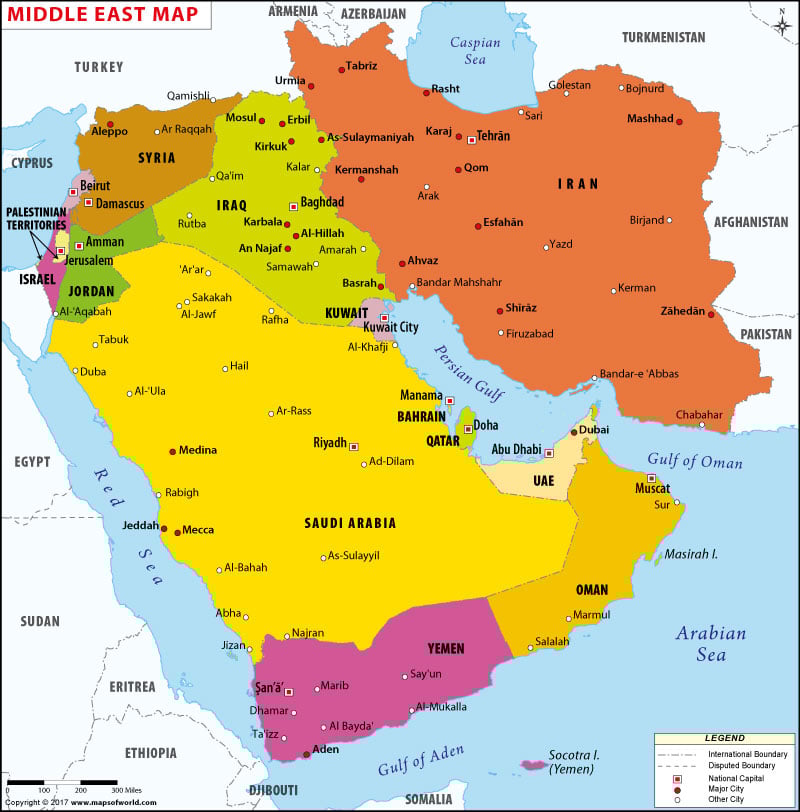
The Middle East: Geopolitical Tensions, Domestic Struggles, and the Quest for Stability
Introduction
The Middle East, a region with deep historical roots and immense strategic significance, is at the heart of many of the world’s most enduring conflicts. From the legacy of the Arab Spring to ongoing wars in Syria and Yemen, and tensions between regional powers like Iran and Saudi Arabia, the Middle East remains a focal point for global geopolitical struggles. At the same time, economic diversification efforts, shifts in regional alliances, and social reform movements are shaping new dynamics. This analysis explores the primary conflicts, emerging trends, and future challenges that define the Middle East today.
Iran and Saudi Arabia: A Regional Power Struggle and the Proxy Wars
Conflict Overview:
The rivalry between Iran and Saudi Arabia is central to many Middle Eastern conflicts, as each seeks to expand its influence. This rivalry plays out in multiple theaters, including Yemen, Syria, Lebanon, and Iraq, where both nations support opposing factions. While Iran uses its Revolutionary Guard and allies like Hezbollah to exert influence, Saudi Arabia relies on financial leverage, traditional alliances, and regional coalitions.
Current Dynamics:
The recent Chinese-brokered rapprochement between Iran and Saudi Arabia marked a significant shift, with both countries signaling a desire to reduce direct tensions. However, proxy conflicts persist, particularly in Yemen, where Saudi Arabia leads a coalition against Houthi rebels backed by Iran. Iraq and Lebanon also remain arenas for Iran-Saudi competition, with each country’s sectarian divisions being leveraged by external actors.
Key Actors:
- Iranian government and the Islamic Revolutionary Guard Corps (IRGC)
- Saudi Arabian government and Crown Prince Mohammed bin Salman (MbS)
- Proxy groups, including Yemen’s Houthis and Lebanon’s Hezbollah
Implications:
The Iran-Saudi rivalry continues to destabilize the region, yet diplomatic openings could offer a path toward de-escalation. While direct conflicts may reduce, the deep-rooted sectarian and geopolitical divisions will likely keep proxy wars simmering. Long-term peace in the region depends on meaningful reconciliation efforts that address underlying grievances and promote regional cooperation.
Israel and Palestine: An Enduring Conflict with New Dimensions
Conflict Overview:
The Israel-Palestine conflict remains one of the Middle East’s longest-standing and most complex disputes. Despite international efforts, a two-state solution appears increasingly out of reach, with Israeli settlements expanding in the West Bank and Gaza’s humanitarian situation deteriorating. Periodic violence erupts, often triggered by flashpoints in Jerusalem and border tensions.
Current Dynamics:
Recent years have seen heightened tensions, with far-right influences in Israeli politics and increasing Palestinian resistance. The Abraham Accords, which normalized relations between Israel and several Arab states, have shifted regional dynamics but have done little to address Palestinian grievances. Escalating violence, particularly in the West Bank, has raised concerns of an intensifying conflict.
Key Actors:
- Israeli government and security forces
- Palestinian Authority (West Bank) and Hamas (Gaza)
- International stakeholders, including the U.S., Egypt, and the UN
Implications:
The Israel-Palestine conflict continues to fuel regional instability and humanitarian crises, undermining prospects for peace. Without renewed diplomatic efforts that prioritize Palestinian rights and security concerns, the situation could lead to more significant violence, further complicating Israel’s relationships with its Arab neighbors and international allies.
Syria: A Protracted Civil War and the Struggle for Reconstruction
Conflict Overview:
Syria’s civil war, which began in 2011, has decimated the country, leading to hundreds of thousands of deaths and displacing millions. The Assad government, backed by Russia and Iran, has reclaimed most of the country, though pockets of opposition remain, particularly in Idlib. The conflict has also attracted external actors, including the United States, Turkey, and various militant groups.
Current Dynamics:
President Bashar al-Assad, having retained power with Russian and Iranian support, is now focused on consolidating control and seeking international rehabilitation. Turkey occupies parts of northern Syria, aiming to prevent Kurdish forces from establishing an autonomous region. Meanwhile, Syria’s reconstruction efforts are hampered by Western sanctions and ongoing insecurity, particularly as ISIS remnants continue attacks.
Key Actors:
- Syrian government, led by President Bashar al-Assad
- Russian and Iranian military forces
- Turkish military and Kurdish-led Syrian Democratic Forces (SDF)
Implications:
The future of Syria hinges on international efforts to support reconstruction, address humanitarian needs, and manage regional power plays. Russia’s involvement, alongside Iran’s influence, keeps Syria within a pro-Iranian axis that alarms neighboring countries. The absence of a clear path to political reconciliation means Syria is likely to remain a fractured and fragile state for the foreseeable future.
Yemen: Humanitarian Catastrophe Amid a Proxy War
Conflict Overview:
Yemen’s civil war, now in its ninth year, has led to one of the world’s worst humanitarian crises. The conflict pits the Houthi rebels, who control the north and are supported by Iran, against the internationally recognized government backed by Saudi Arabia and the UAE. The war has led to massive civilian casualties, widespread famine, and a collapsed healthcare system.
Current Dynamics:
A tentative ceasefire has provided some respite, but peace negotiations remain fragile. The Houthis continue to hold Sanaa, Yemen’s capital, while Saudi-led forces control parts of the south. Iran-Saudi rapprochement offers a potential opening for peace, but deep-rooted tribal and sectarian divisions complicate any permanent settlement.
Key Actors:
- Houthi rebels, aligned with Iran
- Saudi-led coalition, supporting Yemen’s recognized government
- Local tribal factions and the UAE-backed Southern Transitional Council
Implications:
Yemen’s stability is crucial to the security of the Arabian Peninsula, particularly as Yemen sits on key maritime routes. Without a sustainable peace agreement, Yemen risks remaining a breeding ground for extremism and regional instability. The humanitarian toll also undermines the legitimacy of external actors involved in the conflict, emphasizing the need for an inclusive, Yemeni-led solution.
Iraq: Balancing Sectarian Tensions and External Influence
Conflict Overview:
Iraq has faced years of violence and political instability, from the 2003 U.S. invasion to the rise and fall of ISIS. Today, Iraq is a battleground for influence between the U.S. and Iran, each backing different political and militia groups. Sectarian divides between Sunni, Shia, and Kurdish populations further complicate Iraq’s governance.
Current Dynamics:
Iraq’s government, while nominally independent, is heavily influenced by Iran, particularly through Shia militias. At the same time, the U.S. maintains a military presence focused on counterterrorism. Iraq’s vast oil wealth has led to corruption, fueling public discontent and protests, especially among young Iraqis who demand better governance and reduced foreign interference.
Key Actors:
- Iraqi government and Shia militias backed by Iran
- U.S. military forces and local allies
- Sunni and Kurdish political groups
Implications:
Iraq’s struggle to balance its alliances with both the U.S. and Iran puts it in a delicate position. Reducing corruption and fostering national unity are essential to prevent further fragmentation. Iraq’s stability is critical for the wider region, as a strong Iraq could serve as a buffer against extremism and Iranian-Saudi rivalry.
Lebanon: Economic Collapse and Political Gridlock
Conflict Overview:
Lebanon is grappling with one of the worst economic collapses in modern history, coupled with political paralysis. Hezbollah, an Iran-backed Shia militia and political party, exerts significant influence, creating friction with Sunni, Christian, and Druze communities. Political elites have failed to address systemic corruption and provide basic services, leading to widespread poverty and disillusionment.
Current Dynamics:
The Lebanese pound has lost much of its value, and shortages of electricity, water, and healthcare persist. Hezbollah’s power complicates Lebanon’s relationships with neighboring states and Western allies, who view it as a destabilizing force. Lebanese citizens have increasingly taken to the streets, demanding reform, but entrenched political factions resist change.
Key Actors:
- Hezbollah, with support from Iran
- Lebanese government and sectarian political elites
- International donors and the IMF
Implications:
Lebanon’s instability poses risks for regional security, particularly as Hezbollah’s influence grows. Without economic reforms and political renewal, Lebanon risks a further breakdown that could drive mass emigration and heighten tensions with Israel. International aid is critical, but it must be accompanied by accountability and structural reform to stabilize Lebanon.
Regional Dynamics: Climate Change, Water Scarcity, and Economic Diversification
The Middle East faces environmental challenges that transcend borders. Climate change is exacerbating water scarcity, with the Tigris, Euphrates, and Jordan rivers under immense strain. Disputes over water resources, particularly between Turkey, Syria, Iraq, and Iran, could lead to conflict as populations grow and agricultural demands increase.
Economically, many Gulf states are pursuing diversification away from oil through initiatives like Saudi Arabia’s Vision 2030 and the UAE’s investment in technology and tourism. However, the transition remains challenging due to economic reliance on hydrocarbons and political resistance to rapid social changes.
The Role of International Actors: The U.S., Russia, China, and Regional Organizations
The Middle East is a hotspot for global competition, with the U.S., Russia, and China each pursuing distinct interests. The U.S. maintains a military presence, especially to counter Iran and support allies like Israel and Saudi Arabia. Russia’s involvement, particularly in Syria, signals its intent to regain influence lost after the Cold War. Meanwhile, China’s focus is primarily economic, with investments in infrastructure and energy securing its access to the region’s resources and markets. China’s Belt and Road Initiative (BRI) has brought substantial investments in infrastructure projects, especially in the Gulf, as Beijing seeks to establish a stable energy supply and bolster trade routes through the Middle East. This economic foothold contrasts with the more military-driven approaches of the U.S. and Russia, allowing China to engage without direct involvement in regional conflicts.
The European Union also plays a role, particularly in humanitarian aid and supporting diplomatic efforts to stabilize conflict zones, though its influence is limited compared to that of the U.S., Russia, and China. Additionally, regional organizations such as the Gulf Cooperation Council (GCC) and the Arab League strive to foster cooperation, though they often struggle with internal divisions and conflicting national interests.
Conclusion: The Middle East at a Crossroads
The Middle East remains a region of complex and intersecting challenges—sectarian divides, authoritarian governance, environmental pressures, and external influences all contribute to a turbulent political landscape. Peace efforts are stymied by entrenched conflicts, as seen in Yemen and Syria, while the Israel-Palestine issue remains unresolved. Iran-Saudi relations, though recently showing signs of thaw, will continue to shape regional stability.
As countries like Saudi Arabia and the UAE push for economic diversification and social reforms, the region faces both opportunities for transformation and risks of further instability. Whether the Middle East can pivot towards sustainable growth and cooperation will depend on resolving ongoing conflicts, managing water scarcity and climate impacts, and balancing relationships with powerful external actors.
The choices made by Middle Eastern leaders and international partners in the coming years will define whether the region moves towards stability and integration or remains mired in cycles of conflict. How the Middle East navigates this crossroads will have significant implications not only for its own future but for global security, energy markets, and migration patterns.
 Apocalypse Now Threedux: World War Thr33
Leave a comment