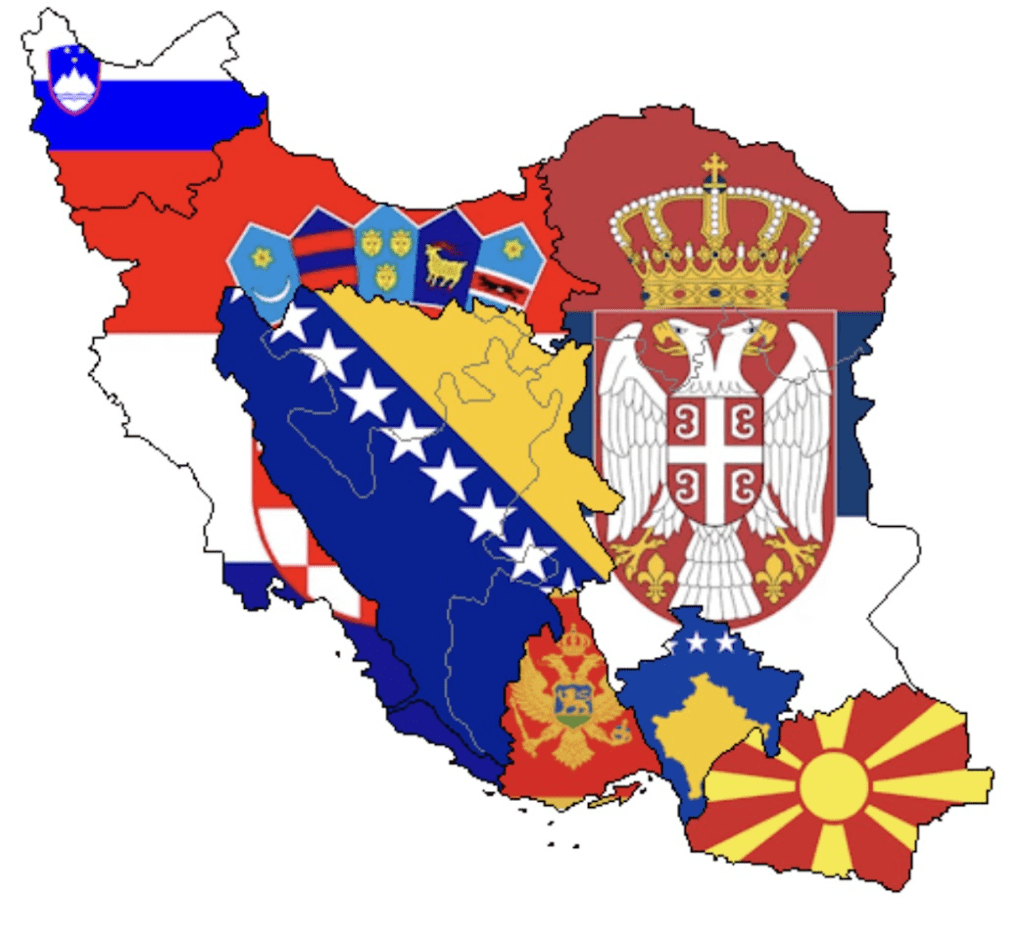
Yugoslavia: The Rise and Fall of a Balkan Experiment
Introduction
For much of the 20th century, Yugoslavia stood as a unique, multinational state that tried to bridge deep ethnic, religious, and political divides in the Balkans. This “land of the South Slavs” was an ambitious experiment, where Serbs, Croats, Slovenes, Bosniaks, Macedonians, Montenegrins, and Albanians coexisted under a single flag. But this unity was fragile, held together by a complex web of political maneuvering, federalism, and a powerful leader in Josip Broz Tito. When Yugoslavia finally fractured in the early 1990s, it wasn’t merely a political breakup; it was an explosive disintegration that unleashed brutal wars, ethnic cleansing, and deep scars that are still felt today. The story of Yugoslavia’s rise and fall is one of idealism, conflict, and the violent consequences of unresolved identity and territorial issues.
The Birth of Yugoslavia: A Kingdom United (1918)
The seeds of Yugoslavia were planted in the aftermath of World War I, as the Austro-Hungarian Empire collapsed and new states emerged across Europe. In 1918, the Kingdom of Serbs, Croats, and Slovenes was established, bringing together ethnic groups with long histories of cultural, religious, and political differences. Under the Serbian monarchy, this new kingdom aimed to create unity, but it quickly became clear that tensions between its ethnic groups would be difficult to manage.
In the 1920s, the state struggled to balance the desires of its constituent groups. Serbs, with a long-standing monarchy and Orthodox Christian heritage, often held dominant political roles, while Catholic Croats and Slovenes, who had been under Austro-Hungarian influence, demanded greater autonomy. The centralized rule under a Serbian monarchy only intensified these divisions, creating a political landscape fraught with resentment, which would become an enduring feature of Yugoslav history.
World War II: Occupation, Resistance, and the Rise of Tito
Yugoslavia’s internal divisions were fully exploited during World War II when Axis forces invaded in 1941. The country was partitioned by Nazi Germany and its allies, who installed a fascist regime in Croatia led by the Ustaše, which committed brutal atrocities against Serbs, Jews, and Roma. At the same time, ethnic tensions flared as different groups took up arms in nationalist and ideological resistance movements.
Out of this chaos, Josip Broz Tito emerged as the leader of the communist Partisans, a multi-ethnic resistance force fighting both the Axis powers and rival nationalist factions. Tito’s charisma, strategic skills, and message of brotherhood helped the Partisans gain widespread support. By the end of the war, Tito had established himself as the leader of Yugoslavia, and in 1945, he founded the Socialist Federal Republic of Yugoslavia, a communist state that pledged to uphold unity and equality among all Yugoslav nations.
Tito’s Yugoslavia: A Delicate Balance of Unity and Control
Under Tito’s rule, Yugoslavia was transformed into a socialist federation composed of six republics: Slovenia, Croatia, Bosnia and Herzegovina, Montenegro, Serbia, and Macedonia. Each republic had a degree of autonomy, and Tito implemented policies that celebrated the region’s diversity under the concept of “brotherhood and unity.” This federal structure was a bold attempt to manage the competing identities and histories that defined the Balkans.
Tito also skillfully positioned Yugoslavia as a non-aligned country during the Cold War, refusing to align with either the Soviet Union or the United States. This independence allowed Yugoslavia to receive support from both sides, giving it an economic and diplomatic advantage. Internally, Tito cracked down on nationalist sentiments and suppressed dissent, enforcing a rigid state ideology. For much of his rule, this approach was effective—Yugoslavia enjoyed a period of relative stability, economic growth, and a unique identity on the world stage.
However, Tito’s leadership was the glue that held Yugoslavia together. His death in 1980 marked the beginning of the end, as the federation soon faced a series of economic and political crises that would test its unity.
The Road to Collapse: Nationalism and Economic Crisis (1980s)
After Tito’s death, Yugoslavia’s unity began to unravel. The country faced mounting economic challenges, including rising debt, high inflation, and increasing unemployment. The centralized economy struggled, and regional inequalities became more pronounced, with Slovenia and Croatia resenting the economic burden of supporting the poorer republics, particularly Serbia and Macedonia.
As economic troubles grew, nationalist sentiments that had been suppressed under Tito started to re-emerge. In Serbia, Slobodan Milošević rose to power on a platform that advocated for greater Serbian influence within Yugoslavia, stirring ethnic pride among Serbs and creating anxiety in other republics. The political elite in Slovenia and Croatia, feeling sidelined by the growing Serbian dominance, began to call for increased autonomy and even independence.
By the late 1980s, Yugoslavia was a federation in crisis, with each republic’s leaders looking out for their own interests. The Yugoslav National Army, once a symbol of unity, became increasingly polarized along ethnic lines. The fragile balance Tito had maintained was gone, and the stage was set for a violent breakup.
The Yugoslav Wars: Ethnic Conflict and Brutal Consequences (1991-2001)
In 1991, Slovenia and Croatia declared independence, prompting the Yugoslav National Army, dominated by Serbs, to intervene. Slovenia’s brief war for independence was relatively bloodless, but Croatia’s path was brutal, as Serbian forces, backed by Milošević’s government, sought to create a “Greater Serbia” by annexing territories with large Serbian populations. This conflict led to atrocities on both sides, and the international community watched as Yugoslavia spiraled into chaos.
The most devastating conflict, however, came in Bosnia and Herzegovina, which declared independence in 1992. Bosnia’s population was a mix of Bosniaks (Muslims), Croats (Catholics), and Serbs (Orthodox Christians), and each group had conflicting aspirations. The Bosnian War quickly turned into one of the bloodiest conflicts in Europe since World War II. Ethnic cleansing, mass killings, and atrocities, most notably the massacre at Srebrenica in 1995, shocked the world and highlighted the brutal nature of the conflict.
The international community was slow to respond but eventually intervened. NATO airstrikes against Serbian forces and the Dayton Accords of 1995 brought an uneasy end to the Bosnian War, though tensions remained. The conflict had left deep scars, with over 100,000 dead and millions displaced, and Bosnia became a divided state, with a fragile government structure designed to accommodate the country’s ethnic groups.
The violence continued until the Kosovo War in 1998-1999, when ethnic Albanians in the Serbian province of Kosovo sought independence. Serbia’s brutal crackdown led to NATO intervention, with a bombing campaign that ultimately forced Serbia to withdraw. Kosovo was placed under UN administration, and it eventually declared independence in 2008, though Serbia and some other countries still refuse to recognize it.
Aftermath: The Legacy of Yugoslavia’s Collapse
The breakup of Yugoslavia left behind a complex legacy of ethnic fragmentation, political instability, and economic hardship. The newly independent states—Slovenia, Croatia, Bosnia and Herzegovina, Montenegro, North Macedonia, and Kosovo—faced the daunting task of rebuilding societies shattered by war. The Balkan conflicts of the 1990s left deep-seated ethnic distrust, unresolved border disputes, and trauma that continues to shape the region’s politics.
Slovenia and Croatia managed to integrate into the European Union, while other former Yugoslav republics have struggled with corruption, economic challenges, and weak governance. Bosnia remains a particularly fragile state, divided between the Serb-dominated Republika Srpska and the Federation of Bosnia and Herzegovina. Kosovo, though recognized by many Western countries, remains a contentious issue, with Serbia continuing to assert its claim to the territory.
The Role of the International Community: Intervention and Reconciliation
The international community’s response to Yugoslavia’s collapse was mixed. Early in the conflict, global powers were hesitant to intervene, underestimating the severity of the violence. The international community’s failure to prevent atrocities like Srebrenica was a stark lesson in the dangers of inaction. The NATO interventions in Bosnia and Kosovo, though controversial, marked a turning point, establishing a precedent for humanitarian intervention.
Today, the EU and UN are heavily involved in post-conflict reconstruction, supporting democratic reforms, promoting reconciliation, and aiding economic development. The EU has used the prospect of membership to encourage reforms and stability in the Balkans, though progress is slow, and ethnic tensions remain a significant barrier to integration.
Conclusion: A Cautionary Tale of Nationalism and Identity
The story of Yugoslavia is a tragic reminder of the dangers of nationalism and ethnic division. The Yugoslav experiment was a bold attempt to forge unity among diverse ethnic groups, but it ultimately fell victim to internal fractures, economic pressures, and leaders who used identity to pursue power. Its collapse unleashed a wave of violence that forever changed the Balkan landscape and left lasting scars on the region’s people.
While Yugoslavia no longer exists, its legacy lives on in the politics, borders, and memories of the Balkans. For the people of the former Yugoslavia, the pursuit of stability, peace, and a shared future remains an ongoing challenge. As they work to rebuild and redefine their identities, the lessons of Yugoslavia’s collapse serve as both a cautionary tale and a reminder of the importance of unity amid
diversity.
The Path Forward: Reconciliation, Integration, and Challenges Ahead
For the nations born out of Yugoslavia’s collapse, the journey toward reconciliation and stability has been long and complex. Ethnic divisions remain a potent force, and the wounds of the wars—trauma, displacement, and distrust—are still fresh for many communities. In Bosnia, ethnic divides are built into the country’s political structure, a necessary compromise to maintain peace but one that often leads to political deadlock and economic stagnation. In Kosovo, the status of its independence continues to stir tension, with Serbia refusing recognition and periodic flare-ups reminding the world of the unresolved nature of this conflict.
The European Union has been a crucial player in the post-Yugoslav landscape, using the promise of EU membership as leverage to encourage peace, reform, and cooperation. Croatia and Slovenia are now EU members, while Serbia, Montenegro, North Macedonia, Bosnia and Herzegovina, and Kosovo each have varying degrees of EU candidacy or partnership status. EU accession provides a framework for these countries to work toward common goals, economic growth, and rule of law reforms—an opportunity to move beyond the nationalist politics that fractured Yugoslavia.
Yet, obstacles remain. The process of integration is slow, and the region still faces issues of corruption, economic challenges, and governance weaknesses. Nationalist rhetoric remains a tool for some political leaders, particularly during election periods, appealing to grievances and past injustices that still resonate deeply within communities. Additionally, Russia has sought to leverage these divides, especially in Serbia, where historical and cultural ties to Moscow are strong. Russian influence in the Balkans poses an additional challenge to the EU’s mission to bring stability to the region.
Yugoslavia’s Legacy: Lessons for a Fractured World
Yugoslavia’s story offers valuable lessons for a world facing its own challenges with nationalism, identity, and division. The experiment of a multi-ethnic federation sought to overcome the divides of language, religion, and history but ultimately succumbed to internal fractures and external pressures. Today, as societies around the globe grapple with questions of identity and unity, Yugoslavia’s collapse serves as both a warning and an invitation to reflect on the costs of division and the importance of fostering mutual understanding.
The people of the former Yugoslav republics are rebuilding, redefining their identities in relation to one another, and working to overcome the legacies of war. Civil society organizations, local reconciliation efforts, and international support have helped foster a generation determined to look forward rather than backward. Many young people in the region, with no memory of the Yugoslav state, are more focused on building a future where their countries can thrive as independent nations but remain interconnected through shared history, culture, and economic ties.
Conclusion: A Region in Recovery, a Future of Possibility
The fall of Yugoslavia left scars that will take generations to heal, but it also left a determination among the people of the Balkans to forge a peaceful and cooperative future. From the devastation of war, new paths to prosperity and stability are being built, albeit slowly and unevenly. While old wounds linger, there is a growing recognition across the former Yugoslav republics of the need to move beyond the divisions of the past, embrace unity in diversity, and pursue the peace that Yugoslavia once sought but could not sustain.
As the region looks to the future, it remains a powerful reminder of both the challenges and the potential of coexistence. The breakup of Yugoslavia reshaped the Balkans and changed the course of history, leaving behind a legacy that resonates far beyond its borders. The hope now is that the nations of the former Yugoslavia can continue their journey toward a more peaceful, prosperous, and integrated future, turning the painful lessons of the past into a foundation for resilience, growth, and unity in a world still grappling with the complexities of identity and belonging.
 Apocalypse Now Threedux: World War Thr33
Leave a comment