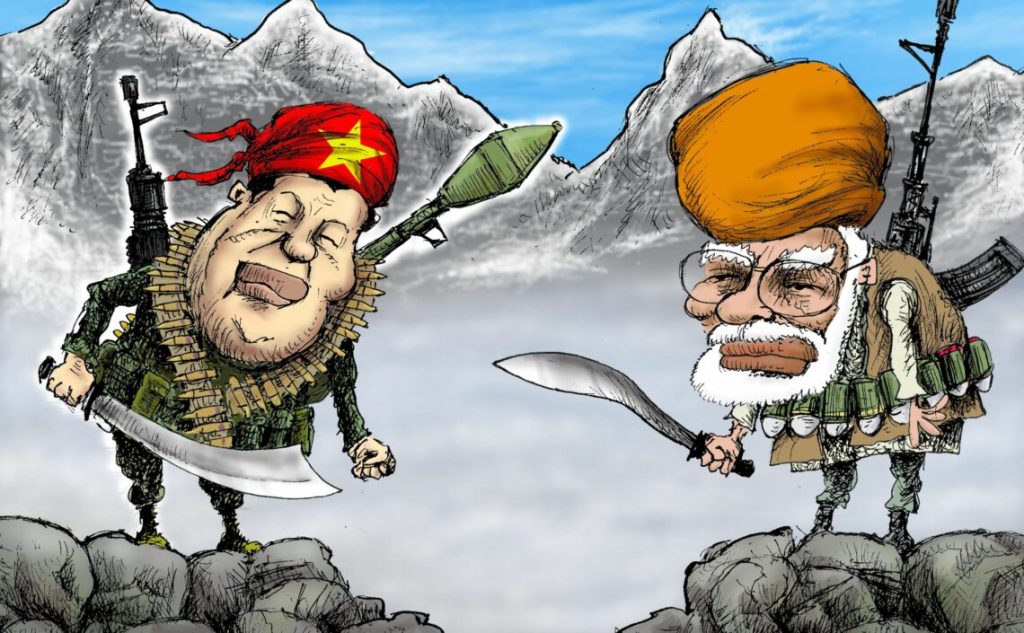
China and India: A Strategic Rivalry and the Fight for Regional Dominance
Introduction
China and India, the world’s two most populous countries, share a long and complex history shaped by cultural exchange, competition, and an uneasy coexistence along their disputed border in the Himalayas. While the two nations once aligned as champions of non-aligned and anti-colonial movements, recent decades have seen their relationship dominated by strategic rivalry, border skirmishes, and economic competition. This rivalry is not only about territorial claims but also about the quest for influence in Asia and beyond. China and India’s relationship is a cornerstone of 21st-century geopolitics, with implications for global security, economic development, and the balance of power in the Indo-Pacific.
Historical Background: From Cooperation to Conflict
India and China have a shared cultural history dating back over two millennia, marked by exchanges of philosophy, religion, and trade. However, as modern nation-states, their relationship has been more turbulent. Following India’s independence from British rule in 1947 and the establishment of the People’s Republic of China in 1949, the two countries initially found common ground, promoting pan-Asian solidarity. This cooperation began to fracture over contested borders in the Himalayas and differing national visions.
In 1962, China and India went to war over their disputed boundary in the Aksai Chin region (administered by China, claimed by India) and Arunachal Pradesh (administered by India, claimed by China). The conflict ended in a ceasefire with China retaining control over Aksai Chin, but the two countries have yet to formally settle their border. The legacy of this war remains a significant source of tension, with both sides reinforcing their military presence along the Line of Actual Control (LAC), a de facto border that continues to be a flashpoint for skirmishes and stand-offs.
The Border Disputes: Himalayan Tensions and the Line of Actual Control
The Himalayas, which form the boundary between China and India, are the epicenter of their territorial disputes. The 1962 war solidified mistrust, and the border has been a recurring source of conflict. The most recent flashpoint occurred in 2020, when Chinese and Indian soldiers clashed in the Galwan Valley, resulting in the deaths of 20 Indian and at least 4 Chinese soldiers—the first fatal border incident in over four decades. The Galwan Valley clash highlighted the fragility of peace along the LAC and intensified calls within India to reassess its relationship with China.
Following the Galwan clash, both countries increased their military presence in the Himalayas, engaging in a high-altitude arms race, with soldiers stationed year-round in inhospitable conditions. The unresolved status of the border creates a constant risk of escalation, while military build-ups add complexity to already strained diplomatic relations. Regular rounds of diplomatic and military talks have sought to de-escalate tensions, but meaningful progress has been elusive.
Economic Competition and the Quest for Dominance
China and India, as two of the world’s largest economies, share extensive trade ties, with China being one of India’s largest trading partners. However, this economic relationship is marked by asymmetry. India imports significantly more from China than it exports, creating a trade imbalance that has sparked debates in India about economic dependence. Following the 2020 border clashes, India adopted a more cautious approach to economic engagement with China, banning numerous Chinese apps and increasing scrutiny of Chinese investments.
India’s drive for economic self-sufficiency, known as Atmanirbhar Bharat (Self-Reliant India), reflects its desire to reduce dependence on China while building its own manufacturing and technology sectors. Meanwhile, China has leveraged its Belt and Road Initiative (BRI) to extend its economic influence across Asia, particularly in South Asia, where India has traditionally been a dominant player. China’s investments in neighboring countries like Pakistan, Sri Lanka, Nepal, and Bangladesh have increased its influence around India’s periphery, fueling India’s concerns of strategic encirclement, often referred to as China’s “String of Pearls” strategy.
The Indo-Pacific and Geopolitical Rivalry
Both China and India have regional ambitions that place them at odds in the Indo-Pacific, a region now central to global trade and security. India, as a member of the Quadrilateral Security Dialogue (Quad) alongside the United States, Japan, and Australia, has positioned itself as a counterweight to China’s influence in the Indo-Pacific. The Quad, though officially described as a forum for promoting “a free and open Indo-Pacific,” is widely seen as a response to China’s growing assertiveness in the South China Sea and beyond.
India’s strategic partnerships with the United States and other Indo-Pacific nations reflect its desire to balance China’s influence and assert itself as a key player in regional security. For its part, China perceives India’s alignment with the Quad as part of a broader U.S.-led effort to contain its rise, creating an additional layer of mistrust between the two powers. This competition has driven both nations to expand their naval capabilities and seek influence in the Indian Ocean, which serves as a crucial transit route for trade and energy supplies.
Strategic Ties and the Pakistan Factor
The China-India rivalry is further complicated by China’s close relationship with Pakistan, India’s long-standing adversary. China and Pakistan have deepened their strategic partnership over the years, with China investing heavily in the China-Pakistan Economic Corridor (CPEC), a flagship project of the BRI that connects China’s Xinjiang region with Pakistan’s Gwadar Port. CPEC runs through Pakistan-administered Kashmir, which India claims as its territory, adding another dimension to the border tensions between China and India.
The China-Pakistan alliance amplifies India’s strategic concerns, as it perceives this relationship as an effort by China to counterbalance India’s influence in South Asia. Military cooperation between China and Pakistan, including arms sales and joint exercises, adds to India’s sense of encirclement. This triangular rivalry has fueled an arms race, with India increasing its defense spending to counter the perceived threats posed by its two nuclear-armed neighbors.
Domestic Challenges and Leadership Dynamics
Domestic politics and leadership styles in China and India also shape their relationship. In China, President Xi Jinping’s vision of a “Chinese Dream” and emphasis on nationalism have reinforced China’s assertive foreign policy stance. Under Xi, China has prioritized sovereignty claims and expanded its global influence, reflecting a more confident and sometimes confrontational approach.
In India, Prime Minister Narendra Modi has similarly embraced a nationalist agenda, with an emphasis on Indian self-sufficiency and assertiveness on the global stage. Modi’s approach to China, particularly after the 2020 Galwan clash, has grown increasingly cautious, with India’s government encouraging economic independence from Chinese products and partnerships. The leadership styles of Xi and Modi, both populist and nationalist, contribute to a competitive dynamic, as neither leader can afford to appear weak in the face of perceived threats from the other.
Environmental and Resource Competition
Both China and India face resource constraints and environmental challenges, adding another layer to their rivalry. Access to water is a growing concern; the two countries share rivers originating in the Tibetan Plateau, including the Brahmaputra, which flows into northeastern India. China’s construction of dams on rivers in Tibet has raised fears in India of potential water shortages or controlled water flows, particularly as climate change impacts regional water security.
Additionally, both countries are heavily dependent on energy imports, and their need to secure energy supplies has intensified their interest in the Indian Ocean and Middle Eastern partnerships. China’s Belt and Road Initiative and India’s attempts to build strategic energy partnerships in the Middle East and Central Asia highlight their competition over access to energy routes and resources that are essential for fueling their growth.
Prospects for Peace and Cooperation
Despite their rivalry, China and India have areas of mutual interest, including trade, climate change, and regional stability. Both countries have engaged in diplomatic mechanisms, such as the Border Personnel Meeting points, to manage tensions along the LAC. Regular talks between military and diplomatic representatives have helped prevent some skirmishes from escalating, though they have not resolved the fundamental disputes.
The BRICS alliance (Brazil, Russia, India, China, and South Africa) and the Shanghai Cooperation Organization (SCO) also provide forums where China and India cooperate on economic and security issues, though the impact of these organizations is limited by their differing strategic goals. Trade, although contentious, remains a significant link; economic decoupling from China could be challenging for India, given the interdependence in sectors such as electronics, machinery, and pharmaceuticals.
Conclusion: A Complex, Competitive Future
The relationship between China and India is one of strategic competition tempered by cautious diplomacy. The two nations’ rivalry is likely to continue shaping the geopolitical landscape of Asia, as their overlapping spheres of influence bring them into frequent contention. From border disputes in the Himalayas to influence in the Indian Ocean and the Indo-Pacific, China and India’s relationship will test the limits of coexistence and diplomacy in an era of rising nationalism.
For both countries, the future hinges on their ability to manage competition without allowing tensions to spiral into open conflict. While cooperation on shared issues like climate change and trade remains possible, longstanding mistrust and competing ambitions will make a sustained partnership challenging. In an interconnected world, the China-India rivalry not only affects Asia but holds global implications, underscoring the importance of strategic stability between two of the world’s most powerful and populous nations.
 Apocalypse Now Threedux: World War Thr33
Leave a comment