The Arab Spring: A Season of Uprising, Hope, and Unfinished Revolutions
Introduction
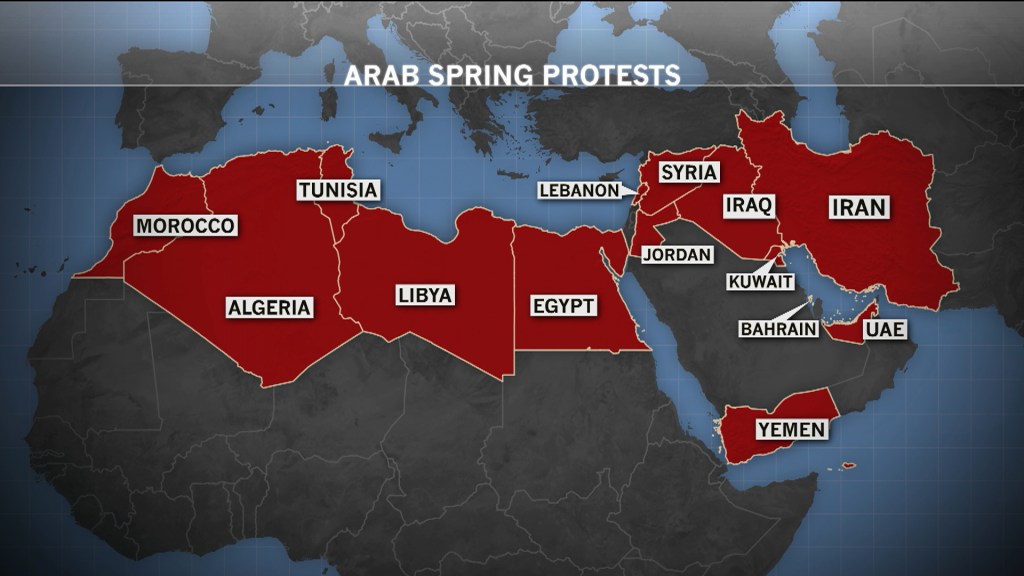
The Arab Spring was a defining moment in modern Middle Eastern history, a surge of people power that swept across the Arab world, demanding change from oppressive regimes. Beginning in late 2010 and peaking through 2011, a wave of protests erupted across North Africa and the Middle East as ordinary citizens called for dignity, democracy, and an end to corruption. This unprecedented uprising reshaped the political landscape of the region, toppling dictators, sparking civil wars, and setting off a struggle between authoritarianism and reform that continues to this day. The Arab Spring was a time of extraordinary hope and profound loss, its legacy marked by both the achievements of civil movements and the challenges that remain.
Origins: Tunisia’s Spark (December 2010)
The Arab Spring began in Tunisia with the self-immolation of Mohamed Bouazizi, a young street vendor who set himself on fire in protest after police harassed him and confiscated his wares. Bouazizi’s act of desperation resonated deeply across Tunisia, sparking widespread protests against poverty, unemployment, and government repression. As anger and frustration boiled over, Tunisians took to the streets, demanding the ouster of President Zine El Abidine Ben Ali, who had ruled the country with an iron grip for over two decades.
By January 2011, Ben Ali fled Tunisia, becoming the first Arab leader to fall to popular protests. The success of the Tunisian revolution sent shockwaves throughout the region, inspiring millions and igniting similar movements across North Africa and the Middle East. The “Jasmine Revolution” became a symbol of possibility, proving that entrenched regimes could be challenged by ordinary citizens.
The Wave of Protests: A Regional Awakening
Following Tunisia, protests erupted across the Arab world. In Egypt, Libya, Yemen, Syria, Bahrain, and beyond, people gathered in public squares and called for change. Each movement was unique, reflecting the specific grievances and aspirations of each country. However, common demands unified these uprisings: an end to authoritarian rule, greater economic opportunity, political freedom, and justice.
Egypt: The Tahrir Square Revolution
In Egypt, inspired by Tunisia, millions gathered in Cairo’s Tahrir Square and cities across the country to demand the resignation of President Hosni Mubarak, who had ruled for nearly 30 years. The peaceful protests in Egypt drew global attention, and after 18 days of relentless demonstrations, Mubarak stepped down on February 11, 2011. Egyptians celebrated what they believed would be the start of a democratic era, though the years to follow would bring new challenges to Egypt’s revolutionary dreams.
Libya: From Uprising to Civil War
In Libya, protests against Muammar Gaddafi’s 42-year rule quickly escalated into an armed conflict. Gaddafi’s forces responded with brutal force, prompting international intervention. NATO launched a military campaign, siding with the anti-Gaddafi rebels and helping to overthrow the regime. In October 2011, Gaddafi was captured and killed. However, Libya’s descent into factional violence and civil war revealed the difficulty of achieving stability after decades of authoritarianism, and Libya remains deeply divided today.
Yemen: A Fragile Revolution
Yemen saw large-scale protests against President Ali Abdullah Saleh, who eventually agreed to step down in 2012 in a Gulf Cooperation Council-brokered deal. Saleh’s resignation marked a victory for Yemen’s opposition, but it left a fragile political structure that soon crumbled into conflict. The power vacuum led to a Houthi rebellion and Saudi-led intervention, pushing Yemen into a protracted civil war with devastating humanitarian consequences.
Syria: The Road to Civil War
In Syria, peaceful protests against President Bashar al-Assad’s regime were met with violent repression. The government’s response to the protests ignited a brutal civil war that continues to this day. Syria’s conflict became a battleground for regional and global powers, drawing in Iran, Russia, Turkey, and the United States. The war has led to massive displacement, human rights abuses, and the rise of extremist groups, leaving Syria shattered and its people suffering deeply.
Bahrain: A Quashed Uprising
In Bahrain, protests led primarily by the Shia majority against the ruling Sunni monarchy were swiftly crushed with the help of Saudi-led Gulf forces. The Bahraini uprising underscored the regional divide between Sunni and Shia powers, with Bahrain’s monarchy supported by Saudi Arabia, while Iran expressed support for the protesters. Unlike in other countries, the Bahraini uprising was quickly contained, leaving deep-seated grievances unresolved.
The Rise and Fall of Democratic Hope
Initially, the Arab Spring inspired optimism that democratic values would take root in the Arab world. Political and social movements brought citizens together across ideological divides, empowered by the belief that a better future was possible. Social media played a pivotal role in organizing protests, spreading information, and uniting citizens across borders, giving the Arab Spring a global platform.
However, the path to democracy proved far more complex than many anticipated. In Egypt, the election of the Muslim Brotherhood’s Mohamed Morsi as president was followed by deep political divisions. In 2013, the military, led by General Abdel Fattah el-Sisi, staged a coup that ousted Morsi and established a new authoritarian regime. In Tunisia, where democratic institutions emerged from the revolution, a fragile political system has struggled under the weight of economic challenges and rising political tensions, culminating in recent steps toward authoritarianism under President Kais Saied.
Regional Repercussions and the Power Struggle: Saudi Arabia, Iran, and Turkey
The Arab Spring fundamentally altered the balance of power in the Middle East, intensifying rivalries and creating openings for regional players to assert influence. Saudi Arabia, Iran, and Turkey all saw the uprisings as opportunities—and threats.
Saudi Arabia and the United Arab Emirates supported the status quo, viewing the Arab Spring as a destabilizing force that could embolden Islamist and democratic movements at home. These Gulf states intervened militarily, economically, and diplomatically to support friendly regimes and suppress opposition movements. Saudi Arabia, in particular, acted swiftly in Bahrain and supported counter-revolutionary efforts in Egypt.
Iran, meanwhile, saw the uprisings as a chance to expand its influence, particularly in Syria, where it supported the Assad regime as part of its “Axis of Resistance” against U.S.-aligned powers. Iran’s support for Shia groups across the region intensified its rivalry with Saudi Arabia, turning the Arab Spring into a sectarian struggle in countries like Syria, Iraq, and Yemen.
Turkey, led by President Recep Tayyip Erdogan, supported many of the protest movements, positioning itself as a champion of political Islam and a regional power. Turkey backed the Muslim Brotherhood in Egypt, and later intervened in Syria, Iraq, and Libya, seeking to expand its influence in the reshaped regional landscape.
The Human Cost and the Refugee Crisis
The aftermath of the Arab Spring has left a devastating human toll. In Syria alone, the civil war has led to over 500,000 deaths and displaced more than 12 million people, creating one of the world’s worst refugee crises. Libya and Yemen, too, have been torn apart, with massive casualties, displacement, and destruction of infrastructure.
Millions of refugees have fled to neighboring countries, particularly Jordan, Lebanon, and Turkey, putting immense strain on these nations and creating long-term challenges for integration and stability. Europe has also felt the impact, with the 2015 migrant crisis highlighting the urgent need for international responses to the humanitarian fallout from the Arab Spring’s aftermath.
The Legacy of the Arab Spring: Unfinished Business
The Arab Spring’s legacy is a mixture of hard-won freedoms, shattered dreams, and unresolved tensions. In Tunisia, the spark that began the Arab Spring, democracy remains fragile yet resilient, a testament to the possibility of political reform. Elsewhere, however, the initial hopes of the uprisings have been replaced by new forms of authoritarianism, economic hardship, and ongoing violence.
The Arab Spring demonstrated the power of collective action, challenging entrenched regimes and inspiring democratic movements worldwide. But it also underscored the complexity of transforming political systems in a region fraught with historical grievances, social divides, and external interference. While the immediate wave of protests has subsided, the underlying forces that drove the Arab Spring—youth unemployment, corruption, political repression, and economic inequality—remain powerful and may yet fuel future uprisings.
Conclusion: A Season of Change, a Legacy of Hope and Struggle
The Arab Spring was a historic moment that reshaped the Middle East and North Africa, offering both a glimpse of hope and a sobering reminder of the challenges facing the region. For millions, it represented a courageous stand for freedom and dignity against entrenched power, a chapter that continues to inspire and haunt the Arab world.
The promise of the Arab Spring remains unfinished, its outcomes diverse and often heartbreaking. Yet, the courage of those who took to the streets echoes on, a testament to the resilience of human aspiration. As new generations emerge, the lessons of the Arab Spring will live on, shaping the dreams, and perhaps the destinies, of those who continue to seek a better, more just future in the Arab world.
 Apocalypse Now Threedux: World War Thr33
Leave a comment